I'm still occasionally finding a pile of deer droppings in the back yard. The hanging soap seems to be working? at least, my chard and beets quit getting eaten, and the forsythia doesn't seem to have any new damage. I'm pretty sure the deer are attracted to the acorns- we have quite a few oak trees and they are producing a bumper crop of mast this year. I gathered up the acorns- raking hard and then sifting through the grass with my fingers in patches. Sorted them- wormy and obviously rotten ones and loose caps went into the compost. I also tossed ones that were sprouting. Toyed with the idea of leeching out tannins and using the good acorns- but I don't know what kind I have. If they are good for eating as nuts, grinding into flour, or pressing for oil- apparently there's a significant difference. Plus it's a bit of work and I remember how un-rewarding the harvest of hickory nuts seemed after a while...
So I ended up just carrying the acorns on a walk into the woods behind our neighborhood and leaving them there for the deer and squirrels. I figure if they're not on the ground in my yard, maybe the deer will quit coming. I'll have to gather more- they're still falling down.
I found out later, that the sprouted ones are actually edible, sometimes even sweeter. So although squirrels and deer might avoid the sprouted acorns and only go for new ones, I could have saved those for myself, if I wanted to clean and process them for use. Maybe another year...
08 October 2017
07 October 2017
tenner...
Well my ten-gallon has one fish in it now-
This week it was getting too cold at night; I moved over the little otocinclus. Here he is- at an angle against the wall. His fins are perky, but he's not very active. I don't know if because there's not quite enough algae, or is he lonely... I bumped the temp back up a little and now he moves around more. Put a new catappa leaf in there, too. He's been nibbling over that.
I swear my rotalas haven't looked so healthy since I had the old 20L. And replacing the floaters worked- the new lot of spirodela polyrhiza in here is slowly multiplying, and growing out healthy roots.
But my favorite plant is still the blue buce 'selena'.
I'm trying to spread out the crypt parva, since from a distance and certain angle it looks like a green cover across the substrate- but the one I ordered was smaller quantity than I thought. So I pulled a few that were kind of not-well-rooted on the left of the tank, and replanted them here on the right.
(Even the short rotalas in the background look nice compared to what they were before).
And wisteria is finally regrowing- I thought that one was a goner, again.
Java fern 'tongue' in the skull-
This week it was getting too cold at night; I moved over the little otocinclus. Here he is- at an angle against the wall. His fins are perky, but he's not very active. I don't know if because there's not quite enough algae, or is he lonely... I bumped the temp back up a little and now he moves around more. Put a new catappa leaf in there, too. He's been nibbling over that.
I swear my rotalas haven't looked so healthy since I had the old 20L. And replacing the floaters worked- the new lot of spirodela polyrhiza in here is slowly multiplying, and growing out healthy roots.
But my favorite plant is still the blue buce 'selena'.
I'm trying to spread out the crypt parva, since from a distance and certain angle it looks like a green cover across the substrate- but the one I ordered was smaller quantity than I thought. So I pulled a few that were kind of not-well-rooted on the left of the tank, and replanted them here on the right.
(Even the short rotalas in the background look nice compared to what they were before).
And wisteria is finally regrowing- I thought that one was a goner, again.
Java fern 'tongue' in the skull-
06 October 2017
new plants! came in the mail
for my main tank. I ordered from a different company this time- WetPlants- figured it would get to me quick as they are located relatively close in NY.
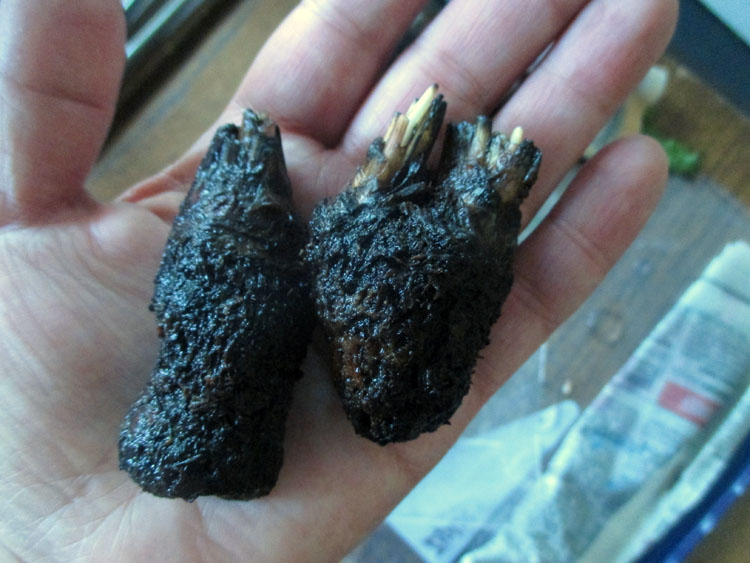
Aponos are not out yet... but their replacement is capuronii bulbs, which probably won't grow out the roots in the few days' overlap. So they can start to adjust in the tank, and get moved into their location after I pull the crispus. Hm, these bulbs don't quite look like the one I got before (from a diff seller). They look- kinda yuck. But hey, if they grow I'm fine with it.
I was also a bit surprised at the crypt parva- I guess I should have paid more attention to the description and ordered a grown pot of it. I got two crowns, and they're three times the height crypt parva grows in my tank. Probably it will melt and revert to smaller size... I was looking forward to separating out tons of tiny plants to fill the foreground of my tenner with this... not happening now.
Here it's in the tank- there's an established (if that's the right word) crypt parva just in front of it on the left. (Nice bolbitis behind!)
The crypt balansae is really robust looking! Its strapping leaves twice the width of mine in tank- but the roots are really scrawny. I wiggled them down into substrate and they held okay.
Well, I don't have a full tank shot yet because it's looking really disorganized now.... in a few days I'm finally pulling out those aponogetons, and re-situating some of these new plants, and then -waiting for it to grow in again.
Aponos are not out yet... but their replacement is capuronii bulbs, which probably won't grow out the roots in the few days' overlap. So they can start to adjust in the tank, and get moved into their location after I pull the crispus. Hm, these bulbs don't quite look like the one I got before (from a diff seller). They look- kinda yuck. But hey, if they grow I'm fine with it.
I was also a bit surprised at the crypt parva- I guess I should have paid more attention to the description and ordered a grown pot of it. I got two crowns, and they're three times the height crypt parva grows in my tank. Probably it will melt and revert to smaller size... I was looking forward to separating out tons of tiny plants to fill the foreground of my tenner with this... not happening now.
Here it's in the tank- there's an established (if that's the right word) crypt parva just in front of it on the left. (Nice bolbitis behind!)
The crypt balansae is really robust looking! Its strapping leaves twice the width of mine in tank- but the roots are really scrawny. I wiggled them down into substrate and they held okay.
Well, I don't have a full tank shot yet because it's looking really disorganized now.... in a few days I'm finally pulling out those aponogetons, and re-situating some of these new plants, and then -waiting for it to grow in again.
window tank...
Night before last I fed Perry his flakes topside, then slid a few sinking wafers in for the cories, after dark. Perry must have noticed after he got all the flake bits that the cories were feeding on something. I watched them closely, saw after a while he had located the wafer and was trying to carry it around. It was too big for him, but he must have gotten a large portion when it softened; in the morning his stomach was distended. I fasted him the next day.
The cories seem to be more reserved- I saw Perry jerking his fins open at them a few times yesterday (his re-grown feeler is almost full length now); I hope he is not going to attack them over food. Yesterday I caught a few mosquito wigglers outside- the puddle is not very productive anymore- I only found five. I was in a hurry and after rinsing just dumped them in the tank, not individual dips like usual. Perry missed them entirely and was watching the surface. I had to leave, but figured he'd locate a few. Cories came out to scout for them, too.
When I got back from errands, found Perry with a dark area dented on top of his head. I think he must have found a mosquito wiggler at surface, lunged for it just under the support bar and hit his head. He doesn't seem bothered by the injury; I will do a few extra wc to keep clean. I'd been using a piece cut from coathanger wire again, to support the lexan lid (it sags in center). This one was starting to rust through and I'm out of coat hangers... so the week before I sanded the rust off and coated it with plastidip.
Today his tank got an extra layer of substrate- I needed more on the short end to support crypt roots
and across the rest it's just slightly thicker.
I got some new plants in today, the java fern 'trident' was intended for this tank- it's got very tall fronds (I expect will grow out shorter)
one leaf had broken off I let that float anyway, to see if it sprouts baby plants. I've also moved in here the anubias congensis, from my other tank.
Top of the tank, pothos is doing better than sweet potato vine. I think the sweet po' doesn't like the chill off the window at night.
It's still kind of a scruffy tank, but I like it.
The cories seem to be more reserved- I saw Perry jerking his fins open at them a few times yesterday (his re-grown feeler is almost full length now); I hope he is not going to attack them over food. Yesterday I caught a few mosquito wigglers outside- the puddle is not very productive anymore- I only found five. I was in a hurry and after rinsing just dumped them in the tank, not individual dips like usual. Perry missed them entirely and was watching the surface. I had to leave, but figured he'd locate a few. Cories came out to scout for them, too.
When I got back from errands, found Perry with a dark area dented on top of his head. I think he must have found a mosquito wiggler at surface, lunged for it just under the support bar and hit his head. He doesn't seem bothered by the injury; I will do a few extra wc to keep clean. I'd been using a piece cut from coathanger wire again, to support the lexan lid (it sags in center). This one was starting to rust through and I'm out of coat hangers... so the week before I sanded the rust off and coated it with plastidip.
Today his tank got an extra layer of substrate- I needed more on the short end to support crypt roots
and across the rest it's just slightly thicker.
I got some new plants in today, the java fern 'trident' was intended for this tank- it's got very tall fronds (I expect will grow out shorter)
one leaf had broken off I let that float anyway, to see if it sprouts baby plants. I've also moved in here the anubias congensis, from my other tank.
Top of the tank, pothos is doing better than sweet potato vine. I think the sweet po' doesn't like the chill off the window at night.
04 October 2017
look at Sassy now!
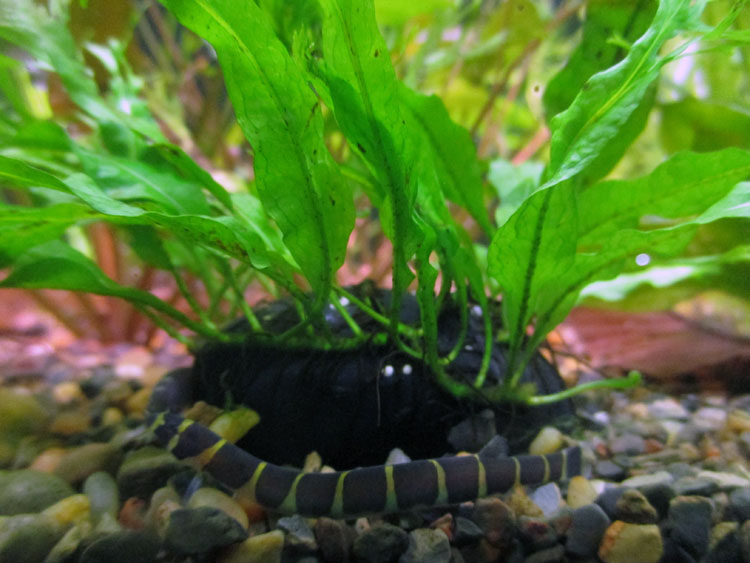
This is the striped kuhli I was so worried about, always thinner than the others. Not any more! I really think it is from two things: once or twice a week feeding of sinking hikari wafers, and addition of leaf litter. Not sure if the kuhli is feeding off the biofilm on the leaves, feels more secure underneath them, or benefits from properties in the tannins, but nevertheless I'm very pleased!
I made sure to get more of these guava leaves in my next order from Tannin Aquatics- it's so cute to see the kuhlis underneath them, little leafy shelters.
03 October 2017
plants in the main
I'm noticing more changes since I took out those large apono crispus. (Cool weather is the best to ship plants- I mailed subwassertang trimmings to someone today -the bunch that had been in my fry box- and next week after sending out the last two aponos I'll be getting a few new plants myself.) Removal of the aponos has caused more black algae spots to crop up on buce and larger anubias. I took out the last of the buces this past friday. After removing the algae-riddled leaves, half of it (it was one smallish cluster that easily divided into four plants) went into the window tank, half into my tenner where they seem to do best. Thinking of doing the same with anubias afzelii and anubias congensis...
Also removed the last, smallest crypt retrospiralis- I want a clear view of the bolbitis fronds on the driftwood from the short end of the tank. They are getting quite a bit taller. I shone a light from the side during my last maintenance trim, so I could see where the fronds were blackened with algae- older leaves I assume- and I trimmed those all out.
The two bolbitis pieces I experimentally put in the window tank don't look so happy- at least, they are not doing anything. No growth, no obvious decay either. But the larger rhizomes and fronds I put in this main tank- they all have new fiddleheads coming up! I am so happy. You can just see one here in the center of the photo, above the subwassertang.
I love fiddlheads. Here's a tiny one coming off the java fern 'windelov', has just uncurled:
My other windelov in here is starting to 'walk' off the anchor stone.
It happens to be right next to those flat pebbles of flame moss, which are still doing poorly but might recover now they have more light. I trimmed them back, waiting to see. Meanwhile, I could just push one of those pebbles next to the windelov, let its rhizome creep over and cling of its own accord. Then cut between the two and have a new windelov piece... Behind those pebbles are the new stems of hygro corymbosa I planted. I'm waiting to see what shape the new leaf growth has. If it keeps different form than the other, I'll assume my older plants are hygro polysperma? (I'm not the only one confused about this- found several forum conversations where people are trying to figure out exactly which form of hygrophila their 'temple plant' is. Maybe it's a hybrid).
Here's another pic of it- original hygro thicket in the rear, new stem planting in front of it.
And here's one that show the bolbitis fronds:
I've noticed with removal of those aponogetons, there is better current in the tank. I think the long leaves were obstructing the flow! More plants sway gently now, and I hadn't seen that effect in a long time. Also elodea is showing much better color than it has in a long time, and hornwort on the surface is growing long, nicely spaced needles again. I don't know how the apono leaves could have kept light from hornwort, as the stems floated above them. I suppose they were simply competing for nutrients.
My fish seem to appreciate the more open space to swim around in. But they also seem to feel a bit exposed- when I walk near the tank they bunch up, all dart off in the same direction. Seem to feel the need to stick together now. I actually like seeing that- it is pretty to see the fish moving together in tighter group. I hope they don't feel too distressed with the increase of open space, and do intent to plant more apono capuronii, crypt balansae and a few other plants soon, which I hope will fill it back in (without being overwhelming like the apono crispus where).
Last pic: a quick overhead shot I took of the left corner, when the tank was lit with a bedside lamp I set up to see better while trimming.
Also removed the last, smallest crypt retrospiralis- I want a clear view of the bolbitis fronds on the driftwood from the short end of the tank. They are getting quite a bit taller. I shone a light from the side during my last maintenance trim, so I could see where the fronds were blackened with algae- older leaves I assume- and I trimmed those all out.
The two bolbitis pieces I experimentally put in the window tank don't look so happy- at least, they are not doing anything. No growth, no obvious decay either. But the larger rhizomes and fronds I put in this main tank- they all have new fiddleheads coming up! I am so happy. You can just see one here in the center of the photo, above the subwassertang.
I love fiddlheads. Here's a tiny one coming off the java fern 'windelov', has just uncurled:
My other windelov in here is starting to 'walk' off the anchor stone.
It happens to be right next to those flat pebbles of flame moss, which are still doing poorly but might recover now they have more light. I trimmed them back, waiting to see. Meanwhile, I could just push one of those pebbles next to the windelov, let its rhizome creep over and cling of its own accord. Then cut between the two and have a new windelov piece... Behind those pebbles are the new stems of hygro corymbosa I planted. I'm waiting to see what shape the new leaf growth has. If it keeps different form than the other, I'll assume my older plants are hygro polysperma? (I'm not the only one confused about this- found several forum conversations where people are trying to figure out exactly which form of hygrophila their 'temple plant' is. Maybe it's a hybrid).
Here's another pic of it- original hygro thicket in the rear, new stem planting in front of it.
And here's one that show the bolbitis fronds:
I've noticed with removal of those aponogetons, there is better current in the tank. I think the long leaves were obstructing the flow! More plants sway gently now, and I hadn't seen that effect in a long time. Also elodea is showing much better color than it has in a long time, and hornwort on the surface is growing long, nicely spaced needles again. I don't know how the apono leaves could have kept light from hornwort, as the stems floated above them. I suppose they were simply competing for nutrients.
My fish seem to appreciate the more open space to swim around in. But they also seem to feel a bit exposed- when I walk near the tank they bunch up, all dart off in the same direction. Seem to feel the need to stick together now. I actually like seeing that- it is pretty to see the fish moving together in tighter group. I hope they don't feel too distressed with the increase of open space, and do intent to plant more apono capuronii, crypt balansae and a few other plants soon, which I hope will fill it back in (without being overwhelming like the apono crispus where).
Last pic: a quick overhead shot I took of the left corner, when the tank was lit with a bedside lamp I set up to see better while trimming.
plants in the window tank
I moved in the last, smallest crypt retrospiralis. I've read that this is one of the tougher crypts and does fine in lower temps, so I thought to put them all in my unheated tank. Of course they're melting now, but all have new roots growing out! I held down a few with stones to keep them in place while they root themselves. Planning to add a bit more substrate, too. There's Perry on the left.
I also moved into here two small buces from the main tank- they are getting too much algae now so I thought would do better in here (the other portion of that 'emerald green' buce went into my tenner). I'm thinking of putting a few of the taller anubias in here, too. I can't see them well where they are situated in the background of my main tank, and they get algae from too much light now, as well. Came across an account where a guy left his tank on vacation, and the thermostat was turned down so low to save energy that when he came back it was just a few degrees above freezing. Many of his plants died (and all his fish) but the crypts grew back, and the anubias didn't suffer at all. So.
02 October 2017
berried shrimps!
End of last week I noticed something different about my amano shrimps. The two largest were definitely berried- carrying eggs in their swimmeretes. Looking close I could see small dots in the center of each tiny egg- rows and rows of them thick under the shrimp. Here's the best I could do at photos. On one shrimp the eggs looked very pale grey or clear-
and when she perched underneath an aponogeton leaf, the eggs looked green from the light coming through the leaf tissue!
The other shrimp, her eggs appeared to be orange. I don't know what causes the variation- the stage of development?
Here you can see both of them- the one with orange eggs on the left, the one with white eggs on the right, lower part of the intake sponge. Up top on the intake tube there's a smaller amano shrimp.
The shrimp were flipping their swimmerete legs to fan the eggs, a motion that seemed odd when I first saw it, that's what made me notice. I really wanted to see the moment they dropped the eggs or released the larval zoes- which won't survive if not transitioned to salt water and back again- a very painstaking process I've read about, so I'm not planning on saving/raising any baby shrimps. They would just be fish snacks- but I missed the moment. Next day the shrimps' swimming legs looked free of burden, and they were rubbing/cleaning them in another motion I hadn't seen before. Well, maybe there will be a next time. I've read that once they start producing eggs, the female shrimps are constantly carrying some.
Younger amano and an older one- they're catching up fast!
and when she perched underneath an aponogeton leaf, the eggs looked green from the light coming through the leaf tissue!
The other shrimp, her eggs appeared to be orange. I don't know what causes the variation- the stage of development?
Here you can see both of them- the one with orange eggs on the left, the one with white eggs on the right, lower part of the intake sponge. Up top on the intake tube there's a smaller amano shrimp.
The shrimp were flipping their swimmerete legs to fan the eggs, a motion that seemed odd when I first saw it, that's what made me notice. I really wanted to see the moment they dropped the eggs or released the larval zoes- which won't survive if not transitioned to salt water and back again- a very painstaking process I've read about, so I'm not planning on saving/raising any baby shrimps. They would just be fish snacks- but I missed the moment. Next day the shrimps' swimming legs looked free of burden, and they were rubbing/cleaning them in another motion I hadn't seen before. Well, maybe there will be a next time. I've read that once they start producing eggs, the female shrimps are constantly carrying some.
Younger amano and an older one- they're catching up fast!
cooler nights
Last night it was finally cold enough for our heater to kick on- below 68°. First thing this morning I checked on my unheated fish tank- it was 69°. My otocinclus catfish still alive, but very lethargic- just sits in one place on the driftwood, not busy feeding. Too cold for this little fish. I moved him this morning into my empty tenner. Where I had recently adjusted the temp down to 74°- in case I needed to move the peppered cories in to get them away from Perry. Right now Perry and the cories all look fine.
I've found a few ways to manage feeding them both. Perry has very sharp eyes and is much quicker to dart after a mosquito wiggler than my betta ever was. If I sprinkle a bit of gold pearls on the surface, he is kept busy picking at the little specks of food (and likes them very much!) at the same time I can sprinkle some down into the lower area of the tank. The food bits fall down where the cories can reach them, and by the time Perry is done looking for all the food at the surface, most of the pearls at the bottom have settled between substrate grains. Perry can't find them easily there, but the cories can locate with their barbels.
My other method is to wait until well after dark. It doesn't matter if Perry appears to be sleeping- resting very still under a bit of driftwood or between the filter box and the wall. As soon as my footsteps come near or my form a shadow upright outside the tank, he is right there at the glass expectantly. I can't sneak up on him. But I can sprinkle some finely crumbled flake at surface where he can just see it- I even take pains to pick out the pale yellow colored flakes from the container. Then softly drop a few sinking wafers in for the catfishes, on the other side of the tank while Perry is busy up top. The wafers are dark brown color, so Perry can't see them well in the dark, I think. In the morning his tummy is awfully fat, so I guess he did get some of it after all. But after a week, the cories still look okay I hope they're getting their fair share.
Regular servings of flake, betta bits, algae wafer or crushed shrimp pellet I can't keep from Perry. He spots the food right away- and goes meticulously across the substrate looking for every last bite of it. It looks like strong competition for the cories. So I am keeping a good amount of leaf litter in this tank, to make sure they have plenty of biofilm also. I ordered more from Tannin Aquatics- my first lots of leaves is disintegrating- especially the catappa leaves, those fall apart quickest. There are still some guava leaf and loquat intact.
I've found a few ways to manage feeding them both. Perry has very sharp eyes and is much quicker to dart after a mosquito wiggler than my betta ever was. If I sprinkle a bit of gold pearls on the surface, he is kept busy picking at the little specks of food (and likes them very much!) at the same time I can sprinkle some down into the lower area of the tank. The food bits fall down where the cories can reach them, and by the time Perry is done looking for all the food at the surface, most of the pearls at the bottom have settled between substrate grains. Perry can't find them easily there, but the cories can locate with their barbels.
My other method is to wait until well after dark. It doesn't matter if Perry appears to be sleeping- resting very still under a bit of driftwood or between the filter box and the wall. As soon as my footsteps come near or my form a shadow upright outside the tank, he is right there at the glass expectantly. I can't sneak up on him. But I can sprinkle some finely crumbled flake at surface where he can just see it- I even take pains to pick out the pale yellow colored flakes from the container. Then softly drop a few sinking wafers in for the catfishes, on the other side of the tank while Perry is busy up top. The wafers are dark brown color, so Perry can't see them well in the dark, I think. In the morning his tummy is awfully fat, so I guess he did get some of it after all. But after a week, the cories still look okay I hope they're getting their fair share.
Regular servings of flake, betta bits, algae wafer or crushed shrimp pellet I can't keep from Perry. He spots the food right away- and goes meticulously across the substrate looking for every last bite of it. It looks like strong competition for the cories. So I am keeping a good amount of leaf litter in this tank, to make sure they have plenty of biofilm also. I ordered more from Tannin Aquatics- my first lots of leaves is disintegrating- especially the catappa leaves, those fall apart quickest. There are still some guava leaf and loquat intact.
01 October 2017
coleus, mint, salvia
Potted up my cuttings today-
Both cuttings of salvia had grown roots now. They look smaller because I pinched off the biggest leaves. I'm going to grow them in the pots for a week or two, then plant them out hopefully they will settle in and survive the winter. If I recall, the ones I transitioned like this before, did better than newly rooted cuttings I stuck straight in the ground.
The mint cuttings in jar had whitefly, and I didn't notice until some withered. I threw out the worst stems, seeing what can salvage. Soaked them in a bowl of soapy water for ten minutes and yeah, lots of tiny bugs got knocked off.
Some of the stems had tiny new leaves emerging under water in the jars, with more roots sprouting above those nascent leaves on the stem. I cut them in half above the leaves, and planted the lower halves separate:
My favorite of the coleus is this odd one with rounded leaves-
Here's some of the others lined up on windowsills.
Both cuttings of salvia had grown roots now. They look smaller because I pinched off the biggest leaves. I'm going to grow them in the pots for a week or two, then plant them out hopefully they will settle in and survive the winter. If I recall, the ones I transitioned like this before, did better than newly rooted cuttings I stuck straight in the ground.
The mint cuttings in jar had whitefly, and I didn't notice until some withered. I threw out the worst stems, seeing what can salvage. Soaked them in a bowl of soapy water for ten minutes and yeah, lots of tiny bugs got knocked off.
Some of the stems had tiny new leaves emerging under water in the jars, with more roots sprouting above those nascent leaves on the stem. I cut them in half above the leaves, and planted the lower halves separate:
My favorite of the coleus is this odd one with rounded leaves-
Here's some of the others lined up on windowsills.
moth on the screen door-
such a curious appearance. It has the usual cryptic mottling to look like tree bark- but what's different from other moths I see is the wings are notched on the rear edge. It held the tail end of abdomen curved up over its back, and looked like the front pair of legs stretched out in front of it- maybe to look like large pincers? It's also darker than most moths I've seen.
Hard to get a photo- my camera didn't want to focus on something so small and dark in the shade of the porch. Tried to look it up. It has similar appearance to many sphinx moths of VA- but I couldn't quite identify.
Subscribe to:
Posts (Atom)